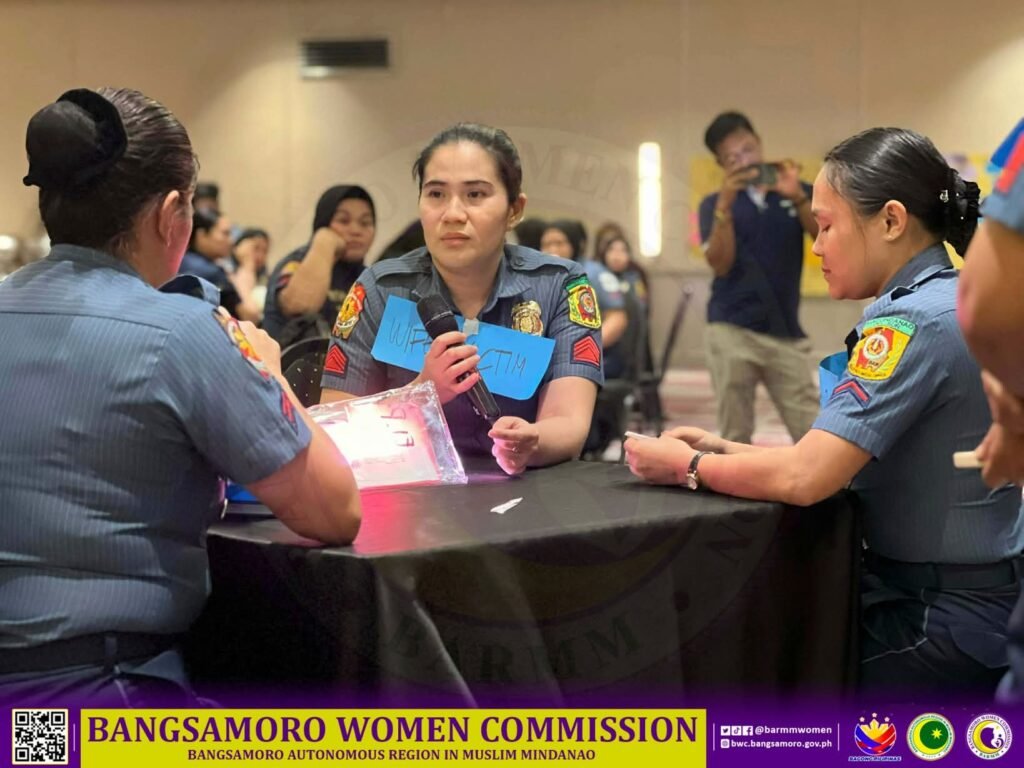
Police officers assigned to Women and Children Protection Desks (WCPD) take part in a three-day capacity-building training spearheaded by the Bangsamoro Women Commission (BWC) from April 14 to 16, 2026, in Davao City. (Photo courtesy of BWC)
COTABATO CITY (April 29) — Efforts to protect women and children in the Bangsamoro Autonomous Region in Muslim Mindanao are gaining ground, as regional agencies and international partners step up coordination against gender-based violence (GBV).
The Bangsamoro Women Commission and the Police Regional Office–BARMM joined forces with Nonviolent Peace force and the United Nations Population Fund to strengthen frontline response systems—starting with intensive training for police officers handling sensitive GBV cases.
Seventy-two officers, including personnel from the Women and Children Protection Desk (WCPD) and investigation units, completed a multi-session training on the Philippine National Police’s guidance for GBV prevention and response.
On the ground, the goal is clear: faster, more sensitive, and survivor-centered support for victims.
“Through strong partnerships, we are equipping frontline responders with the skills to protect, respond, and uphold the dignity of women and children,” said Joenathan Combis.
The training focused on standardizing how cases are handled, improving psychosocial support, and strengthening referral systems—critical gaps often faced by survivors seeking help.
For Bainon G. Karon, the effort is rooted in lived realities.
“At the heart of this training are the stories of mothers and daughters who deserve a life free from violence,” she said.
Police Capt. Rachelle G. Magpatoc underscored that no single agency can address GBV alone, pointing to the importance of coordination across sectors.
“The cases we handle are complex,” she said. “By working together, we ensure that justice is pursued while respecting the dignity and rights of every Bangsamoro.”
The initiative forms part of the BABAE Project of Nonviolent Peaceforce, which links protection efforts with broader goals—expanding access to health services, strengthening community support systems, and promoting peace.
For communities across BARMM, the collaboration signals a shift toward more responsive protection systems—where survivors are not just heard, but supported every step of the way.