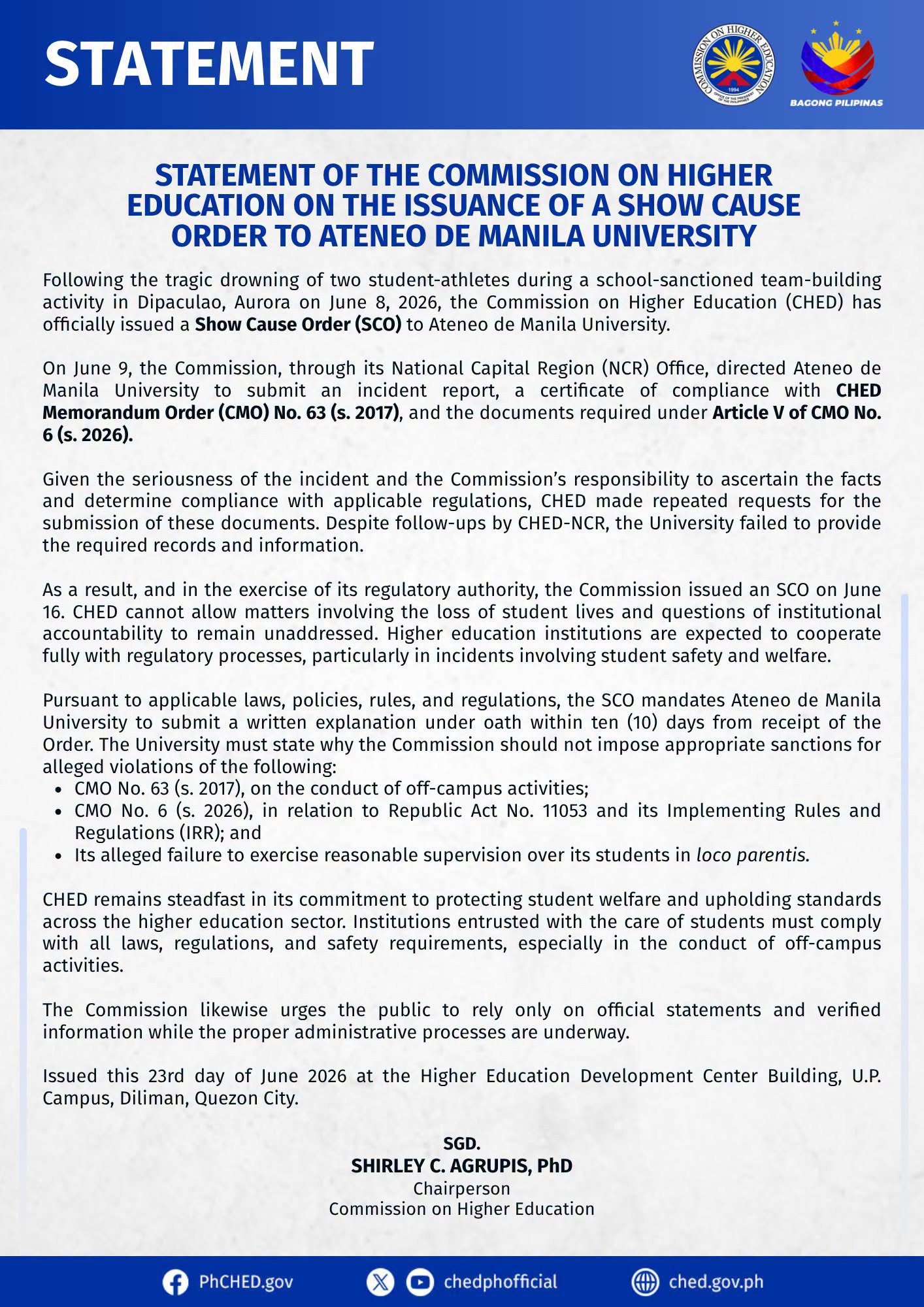
MANILA(June 25) — More than two weeks after two Ateneo de Manila University basketball players drowned during a team-building activity in Aurora, the Commission on Higher Education (CHED) has escalated its investigation, ordering the university to explain why it should not face sanctions over the tragedy.
The June 16 show cause order marks a significant turning point in a case that has evolved from a heartbreaking accident into a broader examination of how educational institutions protect students under their care.
At stake is more than compliance with regulations. The issue now confronting Ateneo is whether enough was done to ensure the safety of two young athletes whose deaths have shaken the country’s collegiate sports community.
A Tragedy Under Scrutiny
Rookies Rene Clert “Bobet” Baterbonia and Divine Adili drowned on June 8 during a school-sanctioned team-building activity in Dipaculao, Aurora.
In the days that followed, grief quickly gave way to difficult questions.
What safety protocols were in place? Was the activity properly assessed for risk? Were adequate safeguards and emergency measures available? And if warning signs existed, were they recognized in time?
Those questions have only intensified after CHED revealed that it had repeatedly sought documents from Ateneo beginning June 9 but allegedly did not receive the records it requested.
According to CHED, the university was asked to submit an incident report, proof of compliance with regulations governing off-campus activities, and documents required under the agency’s anti-hazing policy.
The commission’s frustration became evident in its public statement.
“CHED cannot allow matters involving the loss of student lives and questions of institutional accountability to remain unaddressed,” CHED Chairperson Shirley Agrupis said.
Beyond Regulatory Compliance
The show cause order cites possible violations involving off-campus activity regulations, anti-hazing policies, and the principle of in loco parentis—the legal responsibility of schools to act in place of parents while students are under their supervision.
Together, they point to a central question: What level of responsibility should institutions bear when students are injured or killed during activities they organize and oversee?
Schools often emphasize character-building, leadership development, and team cohesion through off-campus activities. Yet tragedies repeatedly expose how quickly such activities can become high-risk situations when planning, supervision, or emergency preparedness fall short.
The deaths of Baterbonia and Adili have reignited concerns about whether safety protocols are treated as fundamental safeguards or merely administrative requirements completed before an event proceeds.
The Human Cost Behind the Investigation
For the families, the issue is no longer simply about policy compliance.
Baterbonia was buried Wednesday in his hometown of Talacogon, Agusan del Sur, where thousands joined his final journey home. Adili’s remains were flown back to Nigeria, where his family continues to mourn far from the campus where he pursued his dreams.
Their deaths have left two families grieving, two communities searching for answers, and an entire university confronting questions that cannot be resolved by statements alone.
During a Mass held on the eve of Baterbonia’s burial, Prosperidad Bishop Ruben Labajo voiced a sentiment shared by many supporters.
“Let us pray that the truth will finally prevail and be known to everyone. Let us continue to ask and seek the truth together with prayer,” he said.
The call reflects a growing public expectation that investigations should do more than establish a timeline of events. They should determine whether the tragedy was truly unavoidable or whether lapses in judgment, preparation, or oversight contributed to the loss of two young lives.
A Test of Institutional Accountability
The fallout has already been significant.
Head coach Tab Baldwin and team manager Epok Quimpo have resigned. The UAAP has barred coaching staff who were present during the activity, while authorities continue separate investigations.
But CHED’s intervention broadens the focus beyond individual accountability.
The commission’s action suggests that responsibility may extend to the systems, policies, and institutional decisions that governed the activity itself.
As Ateneo prepares its response, the case is becoming a test of how higher education institutions respond when tragedy occurs under their watch.
For many students and parents, the outcome will help answer a fundamental question: When schools ask families to entrust them with their children, what level of responsibility should they bear when that trust is broken?
The answer may shape not only the future of this investigation, but also how universities across the country approach student safety in the years ahead.