
MANILA (April 13) — Filipino consumers may get immediate relief at the pumps this week, but energy officials warn that the era of cheap fuel may not be coming back anytime soon.
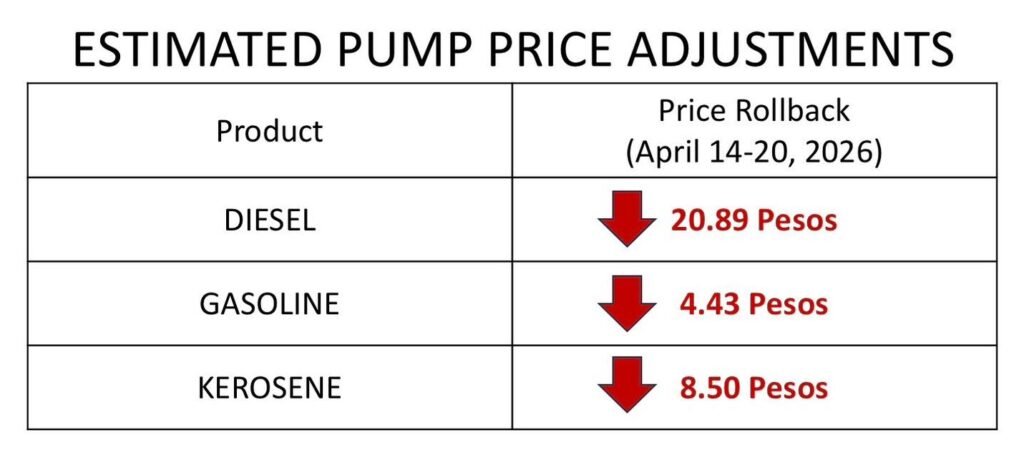
The Department of Energy (DOE) announced an expected “big-time” rollback in fuel prices starting Tuesday, April 14, with diesel projected to drop by P20.89 per liter, gasoline by P4.43, and kerosene by P8.50.
Energy Secretary Sharon Garin said the adjustment reflects easing global prices, based on a five-day average compared to the previous week.
“This is the DOE estimate for the rollback,” Garin said in a public advisory.
Relief—But Only Temporary
While the rollback offers short-term breathing room for transport, fisheries, and households, the DOE stressed that the deeper impacts of the ongoing Middle East conflict could keep fuel prices structurally elevated.
Garin pointed to lasting damage to oil infrastructure caused by tensions involving the United States, Israel, and Iran—disruptions that cannot be quickly reversed even if fighting subsides.
“If the war only lasts two weeks, prices will go down. But the structural damage has already been done,” she said in a radio interview.
Repairs to refineries, storage facilities, and supply routes could take months—if not longer—slowing any sustained decline in global oil prices.
‘No Return to P60’
The clearest signal from the DOE: pre-crisis fuel prices may no longer be realistic.
Before the escalation, diesel hovered around P60 per liter. Garin now says a return to that level is unlikely in the foreseeable future, even with de-escalation.
“Prices may go down, but not as quickly as they went up. We may no longer reach the previous P60-per-liter level,” she said.
Industry Still in Crisis Mode
For fuel-intensive sectors like commercial fishing, the rollback—while significant—may not be enough to reverse ongoing losses.
Operators such as the Southern Philippines Fishing Association, Incorporated (Sophil) have already scaled down operations after diesel prices surged to as high as P155 per liter in recent weeks.
Even with a P20 rollback, prices would remain far above pre-crisis levels, meaning:
- Fishing fleets may continue reduced trips
- Operating costs stay elevated
- Supply chains remain under strain
A Fragile Window
The rollback signals a possible cooling in global oil markets—but also highlights how fragile the situation remains.
For policymakers, the challenge now shifts from crisis response to long-term adaptation:
- Diversifying fuel supply sources
- Strengthening regional trade routes
- Supporting vulnerable industries