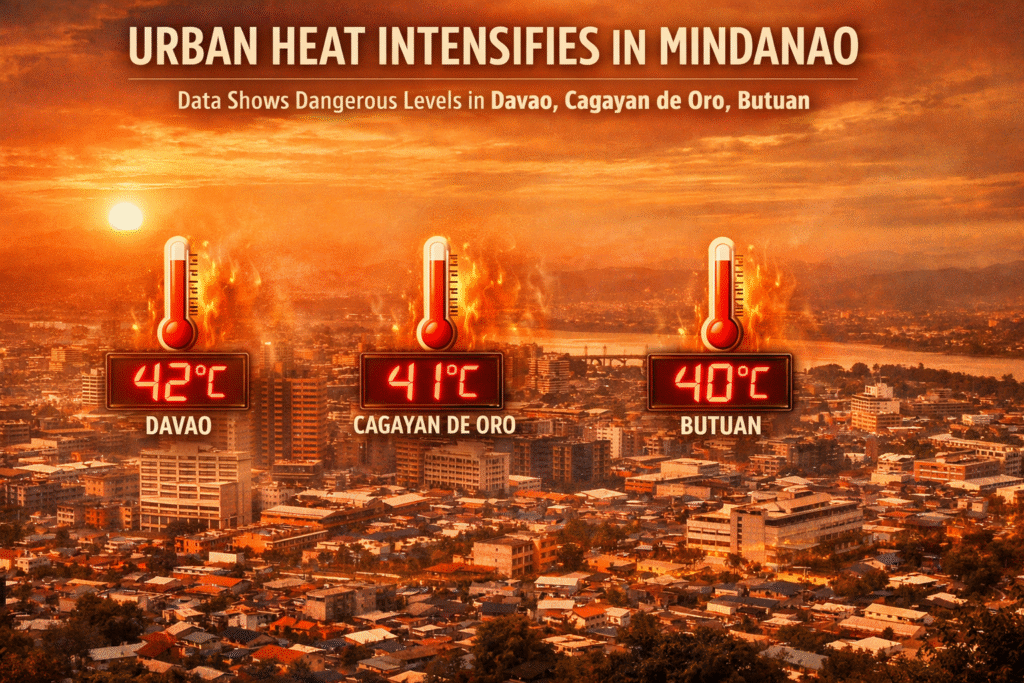
CAGAYAN DE ORO CITY (April 15) — The warning from the Climate Change Commission on rising urban heat is increasingly reflected in data from Mindanao’s key cities, where heat index levels have already entered the “danger” zone in recent years—and are projected to persist.
Across Davao City, Cagayan de Oro, and Butuan City, temperature readings show a pattern of intensifying heat that is no longer seasonal, but structural.
Davao: Consistently in the “Danger” Range
Data from the Philippine weather bureau shows that:
- Davao City has recorded heat index levels of 42°C to 43°C, placing it firmly in the “danger” category
- More recent projections indicate heat indices reaching around 40°C during peak dry season days
At these levels, health risks escalate—from heat cramps to heat exhaustion, with prolonged exposure potentially leading to heat stroke.
Despite being coastal, Davao’s rapid urban expansion—more concrete surfaces, fewer trees—has intensified localized heat retention.
Cagayan de Oro: Rising but Less Visible Heat Stress
In Cagayan de Oro, data is often recorded through nearby stations like Laguindingan Airport, showing:
- Heat index levels around 39°C to 42°C during peak periods
While slightly lower than extreme hotspots, these readings still fall under “extreme caution” to “danger” levels, especially for outdoor workers and commuters.
The city’s fast-paced urbanization and reduced green cover are contributing to rising baseline temperatures, even if they attract less national attention.
Butuan: Among the Hottest in the Country
Butuan City has emerged as one of the country’s most heat-exposed urban centers:
- Recorded heat index of 47°C during recent dry seasons
- Extreme spikes reaching up to 52°C, classified as “extreme danger”
- More recent readings still hover around 41°C to 42°C, within the danger threshold
At these levels, PAGASA warns that heat stroke becomes increasingly likely with continued exposure.
A Regional Pattern: Heat Levels Converging Upward
Across Mindanao, the data reveals a consistent pattern:
- 39°C–41°C → extreme caution (early stress stage)
- 42°C–47°C → danger (heat exhaustion likely)
- 51°C+ → extreme danger (heat stroke imminent)
What was once considered peak-summer extremes is now appearing more frequently—and across multiple cities at once.
Urban Heat Meets Urban Inequality
The numbers are not just scientific—they translate into lived realities:
- In dense barangays in Davao City, limited airflow and heat-trapping materials amplify exposure
- In Cagayan de Oro, commuters and informal workers face prolonged outdoor heat
- In Butuan City, already high inflation compounds the cost of coping (water, electricity, cooling)
Heat becomes not just an environmental issue—but a public health and economic inequality issue.
Pressure on Local Systems
As temperatures rise, cities are experiencing:
- Higher electricity demand, increasing blackout risks
- Water shortages or pressure drops during peak use
- Reduced labor productivity, especially in transport and construction
- Increased health risks, particularly for children and elderly
These pressures intersect with existing challenges—fuel costs, inflation, and infrastructure gaps.
The Urgency of Localized Action
The National Adaptation Plan 2023–2050 aims to address these risks—but data shows urgency is outpacing implementation.
For Mindanao cities, this means shifting from awareness to action:
- urban greening and tree cover expansion
- cooling centers in high-density communities
- climate-sensitive urban planning
- early warning systems for heat spikes