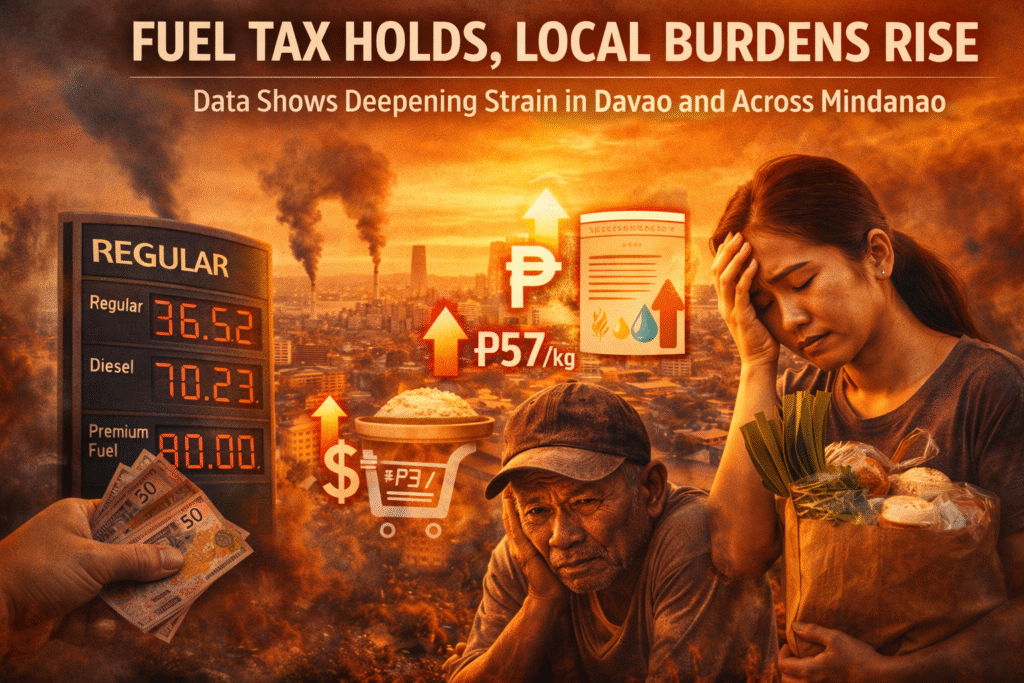
DAVAO CITY (April 15) — The national government’s decision to retain fuel excise taxes comes as both fuel prices and inflation accelerate, amplifying pressure on Mindanao’s local economies and exposing the limits of localized responses to a global energy shock.
While officials in Malacañang warn of a ₱43.6 billion revenue loss if taxes are suspended, recent data suggests that the economic burden on the ground is already escalating—particularly in regions like Davao City.
Fuel Prices: Sharp, Sustained Increases
Recent Department of Energy monitoring shows fuel prices rising at one of the steepest rates in recent years.
- Diesel prices have surged to as high as ₱95 to ₱114 per liter, depending on location
- Gasoline prices have climbed up to around ₱91 per liter
In March 2026 alone, diesel prices increased by as much as ₱20–₱23 per liter, while gasoline rose by ₱12–₱16 per liter in a single adjustment cycle .
On a broader scale, national gasoline prices jumped from $0.98/L in February to $1.52/L in March 2026, reflecting the speed of the spike.
For Mindanao, where fuel must often be transported over longer distances, these increases are magnified at the retail level.
Inflation: Fuel Costs Spilling Into Everyday Life
The impact is now visible in inflation data.
- National inflation rose to 4.1% in March 2026, breaching the government’s target range
- Transport costs alone surged nearly 10% year-on-year, driven largely by fuel prices
In Davao, early signs of spillover are already evident:
- Vendors report rising operating costs, with some considering scaling back or stopping operations amid sustained price increases
- Fuel and transport costs have historically been key drivers of regional inflation, contributing significantly to price increases in goods and services
The pattern is clear: fuel price shocks are no longer isolated—they are feeding directly into food prices, transport fares, and market goods.
Ground-Level Impact: Compounding Pressures
For sectors in Mindanao, the numbers translate into daily trade-offs:
- Transport operators face shrinking margins as diesel costs rise faster than fare adjustments
- Farmers in Bukidnon absorb higher hauling and input costs before passing them on
- Fisherfolk along the Davao Gulf spend more fuel per trip, reducing net income
In Davao’s public markets, even modest price increases accumulate weekly, steadily eroding household purchasing power.
LGU Response: Active but Constrained
Across Mindanao, local governments are responding—but data suggests they are reacting to pressures rather than controlling them.
- Provinces are activating energy contingency plans and monitoring supply chains
- The Bangsamoro Oil Crisis Impact Task Force has been tasked with cushioning price impacts in vulnerable areas
- Cities like Davao are exploring targeted subsidies and transport support
Yet these measures are unfolding against rising baseline costs.
Fuel-driven inflation increases LGU operating expenses—from garbage collection to emergency services—tightening already limited budgets.
A Structural Squeeze
The convergence of three trends is now defining the crisis:
- Rapid fuel price escalation driven by global supply shocks
- Inflation spillover into transport and food systems
- Policy rigidity at the national level, with excise taxes maintained
The result is a downward shift in burden:
- National government protects fiscal space
- LGUs stretch limited resources
- Households absorb rising daily costs