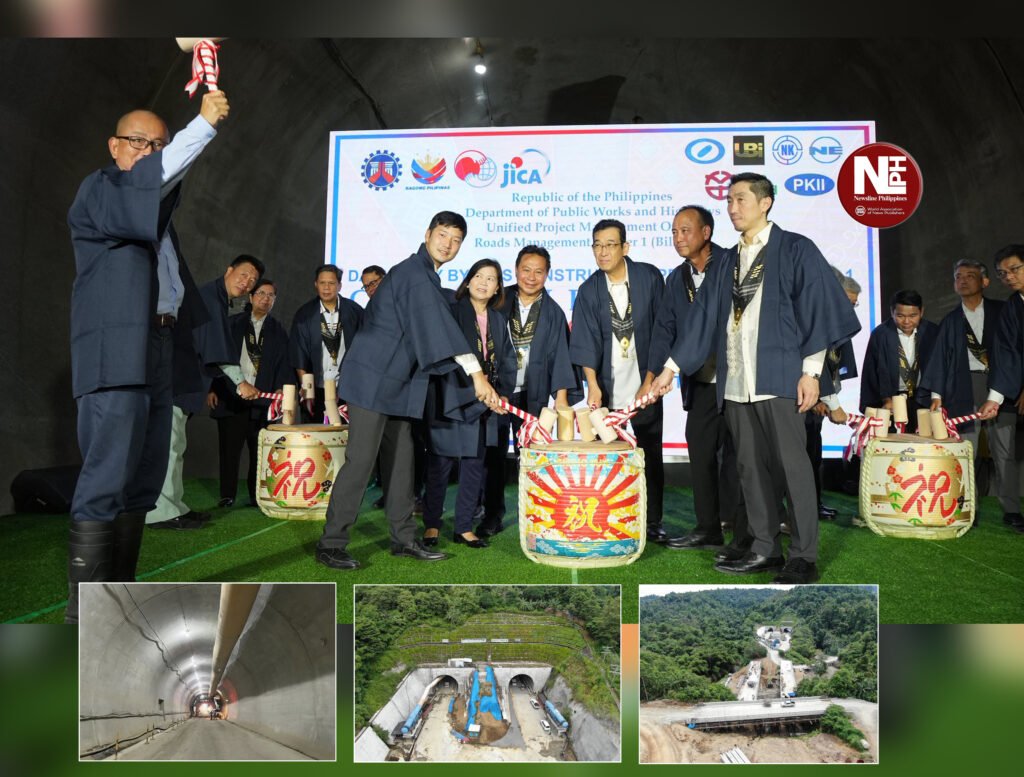
DAVAO CITY (August 31) – A major milestone in Philippine infrastructure was achieved on Friday, August 29, 2025, as the Department of Public Works and Highways (DPWH) held a ceremonial breakthrough for the Southbound Tunnel of the Davao City Bypass Construction Project (DCBCP). The event marked the successful connection of the tunnel’s north and south ends.
The 2.3-kilometer tunnel, part of Contract Package 1-1, is the first long-distance mountain road tunnel in the Philippines and a key feature of the 45.5-kilometer Davao City Bypass. The ceremony was held at the project’s South Portal in Barangay Waan, Davao City, attended by Philippine and Japanese officials, stakeholders, and project partners.
Leading the ceremony were DPWH Senior Undersecretary Emil K. Sadain and Undersecretary Eric A. Ayapana, joined by Japanese representatives including Second Secretary Akito Kinoshita of the Embassy of Japan, Consul General Ono Hirotaka of the Consulate General of Japan in Davao, and JICA Senior Representative Keisuke Fukui. Officials from the Mindanao Development Authority and the Unified Project Management Office (UPMO) also joined the event.
Sadain underscored the significance of the twin-tube tunnel—each tube measuring 10 meters in diameter—which integrates modern engineering technologies.
The southbound breakthrough follows the completion of excavation works for the northbound tunnel in April 2025. Construction of the bypass began in December 2020, with ceremonial launches at both portals held in 2021 and 2022.
Contract Package 1-1, awarded to the Shimizu–Ulticon–Takenaka Joint Venture, covers 10.7 kilometers of a four-lane highway, the 2.3-kilometer tunnel, three river-crossing bridges, two underpasses, and six access roads. The package is now over 61 percent complete and is targeted for completion by October 2026.
To celebrate the partnership, the event also featured Kagami Wari, a Japanese sake barrel-breaking ceremony symbolizing harmony, good fortune, and new beginnings.
The entire bypass project, funded through JICA loans and Philippine government counterpart financing, is divided into several contract packages. Work is steadily progressing across multiple sections, with target completion dates ranging from 2026 to 2027. The final segment, Contract Package 2-3, is now in the procurement stage.
Despite challenges such as difficult terrain and unpredictable weather, DPWH affirmed its commitment to complete the 45.5-kilometer bypass by 2028 within President Marcos’ term. Once finished, the project is expected to ease traffic, boost connectivity, and spur economic growth across Mindanao.