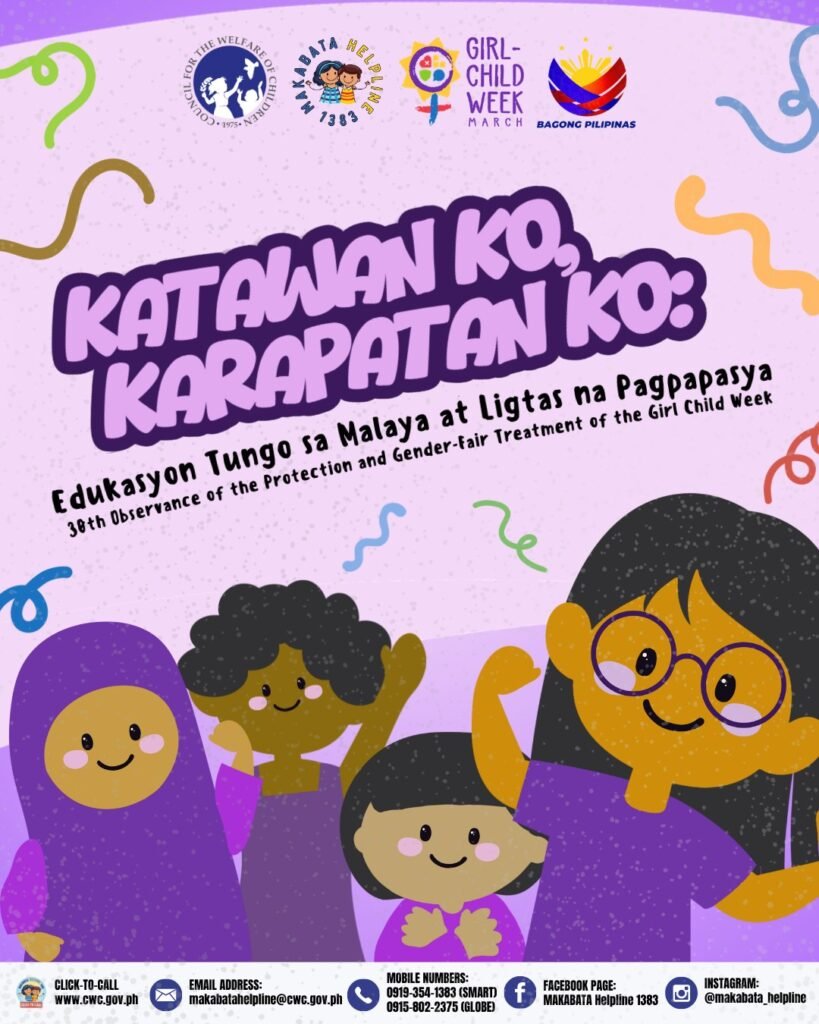
DAVAO CITY(March 26) — As the Philippines marks Girl Child Week 2026, a campaign centered on empowerment is unfolding against a troubling backdrop: a steady rise in pregnancies among the country’s youngest and most vulnerable girls.
With the theme “My Body, My Rights: Education Towards Safe and Informed Decision-Making,” this year’s observance calls for informed choice and protection. But emerging data suggests that for many Filipino girls — particularly in Mindanao — those rights remain unevenly realized.
Recent figures from the Philippine Statistics Authority show that 138,697 girls aged 10 to 19 are already mothers, with cases increasingly shifting toward younger age groups.
More alarming to health officials is the rise in so-called “child pregnancies”: 3,612 births were recorded among girls below 15 in 2024, up from previous years.
“This is a worrying trend,” authorities have said, pointing to growing vulnerability to abuse, exploitation, and early sexual exposure.
A Mindanao Reality
While the issue is national, the burden is not evenly distributed. Regions such as Northern Mindanao and Soccsksargen have recorded over 10,000 adolescent mothers combined, reflecting persistent gaps in access to education and health services.
Earlier studies also show that areas like the Davao Region and the Bangsamoro Autonomous Region have teen pregnancy rates exceeding national averages, often linked to poverty, displacement, and limited access to reproductive health care.
In these communities, advocates say the barriers go beyond infrastructure.
“Even where services exist, stigma, cultural norms, and lack of information prevent girls from accessing them,” a youth worker noted, echoing concerns raised by development groups.
Education Gaps and Policy Limits
Despite policies mandating comprehensive sexuality education, implementation remains inconsistent — particularly in rural and conservative areas.
Experts point to this gap as a key driver of early pregnancy, alongside poverty, family instability, and increasing exposure to online content without adequate guidance.
Advocacy groups have long pushed for stronger legislation, including measures to expand adolescent access to reproductive health services. But efforts such as the proposed Adolescent Pregnancy Prevention Bill have stalled amid political and cultural resistance.
Beyond Awareness Weeks
Officials like Angelo M. Tapales of the Council for the Welfare of Children continue to emphasize education and protection as the foundation of empowerment. Yet advocates argue that awareness campaigns alone cannot address systemic gaps.
“Girl Child Week is important,” one community organizer said. “But girls need sustained protection — in schools, in homes, and in policy.”
Programs in some regions have shown that progress is possible. Localized interventions combining education, youth leadership, and increased funding have reduced adolescent birth rates in parts of the country.
Still, these successes remain uneven and fragile.
A Question of Accountability
As the country celebrates the rights of girls, the contrast between policy and reality is difficult to ignore.
The message of Girl Child Week is clear: empowerment begins with knowledge and choice. But for thousands of Filipino girls — especially those in marginalized communities — the ability to choose remains constrained by systemic failures.
The challenge now is not just to amplify voices, but to translate advocacy into measurable change — ensuring that the promise of rights extends beyond a weeklong observance and into everyday life.