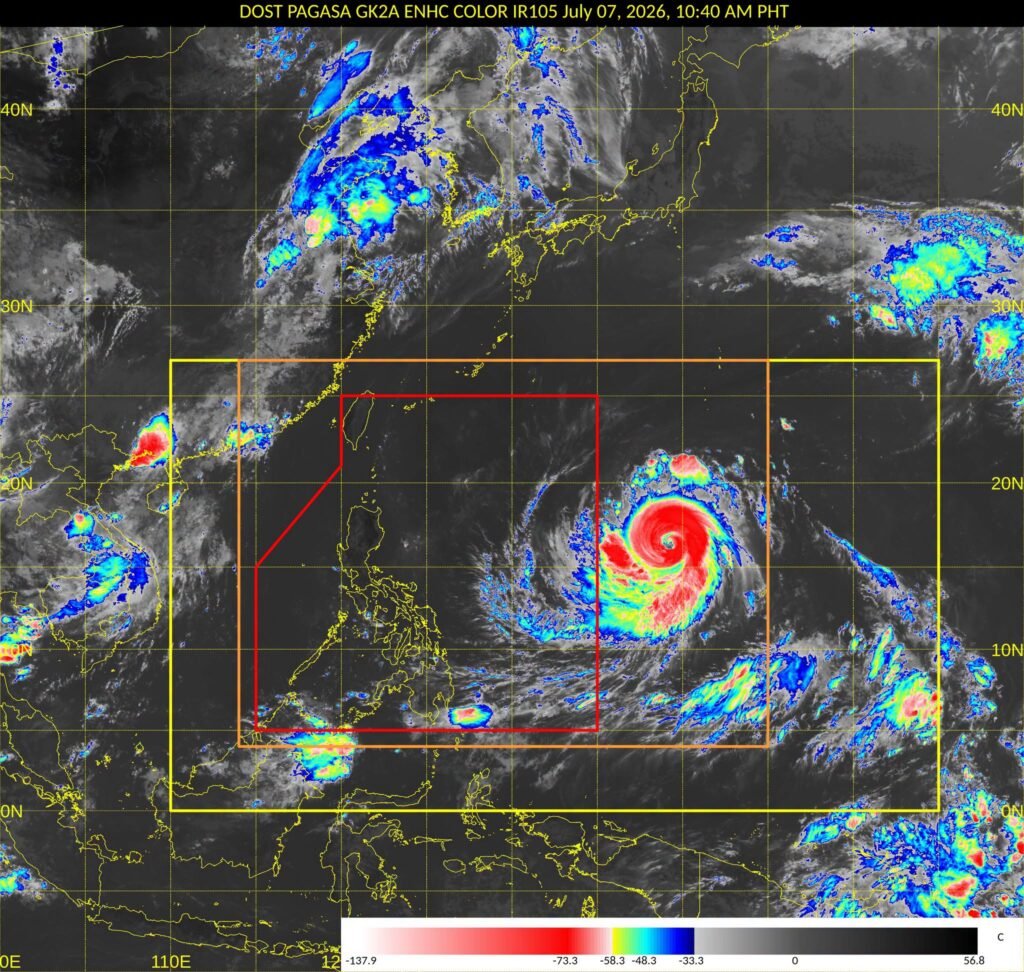
MANILA(July 8) — Even before Super Typhoon Bavi enters the Philippine Area of Responsibility (PAR), government agencies have shifted into disaster mode—stockpiling billions of pesos worth of relief supplies, preparing transport advisories, and warning communities to brace for days of strong winds and heavy rains.
As of 2 p.m. Tuesday, the Philippine Atmospheric, Geophysical and Astronomical Services Administration (PAGASA) tracked Bavi 1,735 kilometers east of Central Luzon, moving west-northwest at 25 kilometers per hour. Once inside PAR, the cyclone will be named “Inday.”
Although the super typhoon is not expected to make landfall, PAGASA warned that its massive circulation, combined with the enhanced southwest monsoon or habagat, could trigger strong to gale-force winds, rough seas, and widespread rains across much of the country through Thursday.
Bavi has maximum sustained winds of 185 kph and gusts of up to 230 kph. Wind Signals No. 2 and No. 3 may be raised over the northern and eastern portions of Northern Luzon by Tuesday night or early Wednesday.
Mindanao is expected to experience strong winds on Tuesday, with the weather system expanding its reach to most of the Visayas, Bicol Region, MIMAROPA, and parts of Luzon on Wednesday before affecting much of the country by Thursday.
Anticipating the storm’s impact, the Department of Social Welfare and Development (DSWD) has prepositioned 4.775 million family food packs worth P3.009 billion, along with 364,283 ready-to-eat food boxes and 271,446 non-food relief items for immediate distribution to affected communities.
DSWD Assistant Secretary Irene Dumlao said the agency has already mobilized field offices to monitor the approaching cyclone and streamline relief operations.
“Hindi na po tayo naghihintay na dumating muna ang sakuna bago tayo umaksyon,” Dumlao said, emphasizing the government’s shift toward proactive disaster response.
The Land Transportation Franchising and Regulatory Board (LTFRB) is also preparing for possible weather-related disruptions, coordinating with PAGASA on areas likely to be affected.
LTFRB Chairperson Vigor Mendoza II said regional offices have been directed to maximize their social media platforms in issuing travel advisories and announcing possible suspensions for buses, UV Express units, trucks, and other public utility vehicles.
The agency is likewise coordinating with the Department of Public Works and Highways on possible road closures and with the Philippine Ports Authority on the suspension of sea travel if conditions worsen.
While Bavi is forecast to stay offshore, disaster managers said its wide-reaching effects could still be felt across the country, prompting authorities to urge the public to closely monitor official weather bulletins, avoid unnecessary travel during severe weather, and prepare for possible flooding, rough seas, and power interruptions.