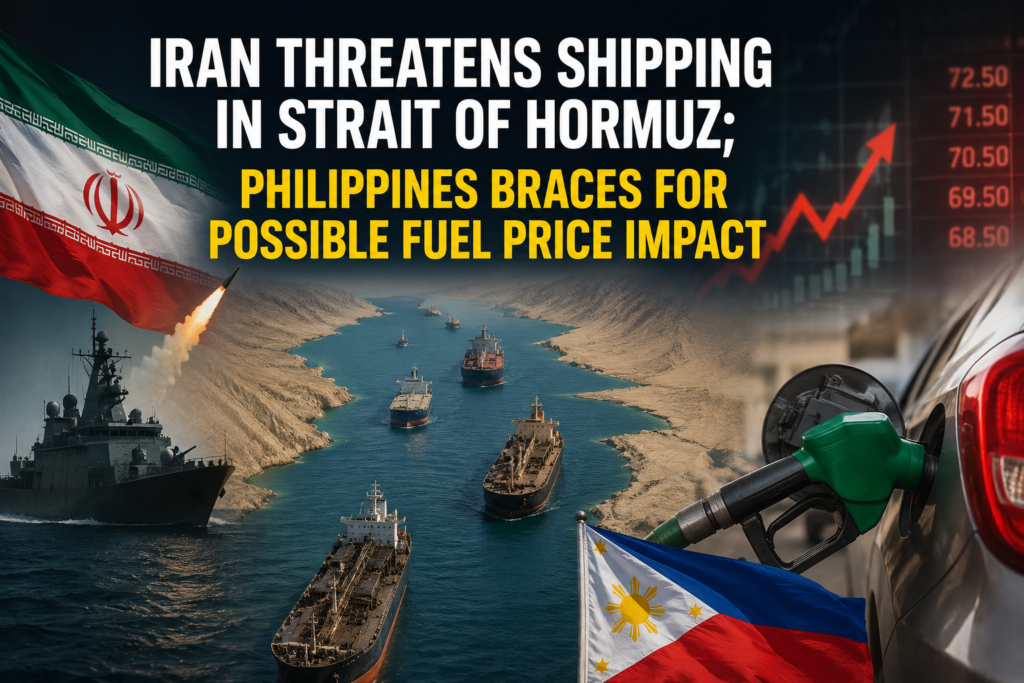
MANILA(June 12) — Iran on Thursday declared that it would target any vessel attempting to pass through the Strait of Hormuz, raising fears of disruptions in global oil supplies and possible economic repercussions for fuel-importing countries such as the Philippines.
Iran’s Khatam al-Anbiya military command announced that the strategic waterway was “completely closed” to vessel traffic and warned that any ship attempting to transit the strait would be considered a target. Iranian state media also reported that two vessels attempting to pass through the area had been struck by Iranian forces.
The threat came after the United States launched a fresh wave of military strikes against Iran, prompting fears of a wider conflict in the Middle East and renewed uncertainty in global energy markets.
The Strait of Hormuz, located between Iran and Oman, is one of the world’s most important oil transit routes, carrying a significant portion of global crude oil and liquefied natural gas exports. Any disruption to shipping in the area can quickly affect international energy prices.
For the Philippines, which imports most of its fuel requirements, a prolonged closure or heightened tensions in the strait could translate into higher pump prices, increased transportation costs, and rising prices of goods and services.
Economists have long warned that geopolitical tensions in the Middle East often have a direct impact on inflation in the Philippines, as fuel costs influence the prices of food, public transportation, electricity generation, and logistics.
Higher oil prices could also place additional pressure on industries dependent on transportation and shipping, including agriculture, fisheries, manufacturing, and small businesses already grappling with elevated operating costs.
Iran’s Revolutionary Guards said the closure was a response to what it described as repeated ceasefire violations by the United States. The military warned vessels in the Persian Gulf and the Sea of Oman not to approach the Strait of Hormuz, saying any attempt to do so would be treated as cooperation with the enemy.
Despite the announcement, reports indicated that some commercial vessels were still navigating the area, while US officials maintained that maritime traffic remained active.
The escalating tensions have already unsettled global markets, with traders closely monitoring developments in the region. Energy analysts warn that even without a full blockade, heightened security risks and increased shipping insurance costs could push oil prices upward.
For countries like the Philippines, the concern extends beyond fuel prices. Rising energy costs could affect household budgets, transportation fares, food prices, and overall inflation, potentially slowing economic growth and adding pressure on consumers.
As diplomatic efforts struggle to contain the conflict, governments around the world are watching developments in the Strait of Hormuz closely, aware that events unfolding thousands of kilometers away could have immediate consequences for local economies and everyday living costs.