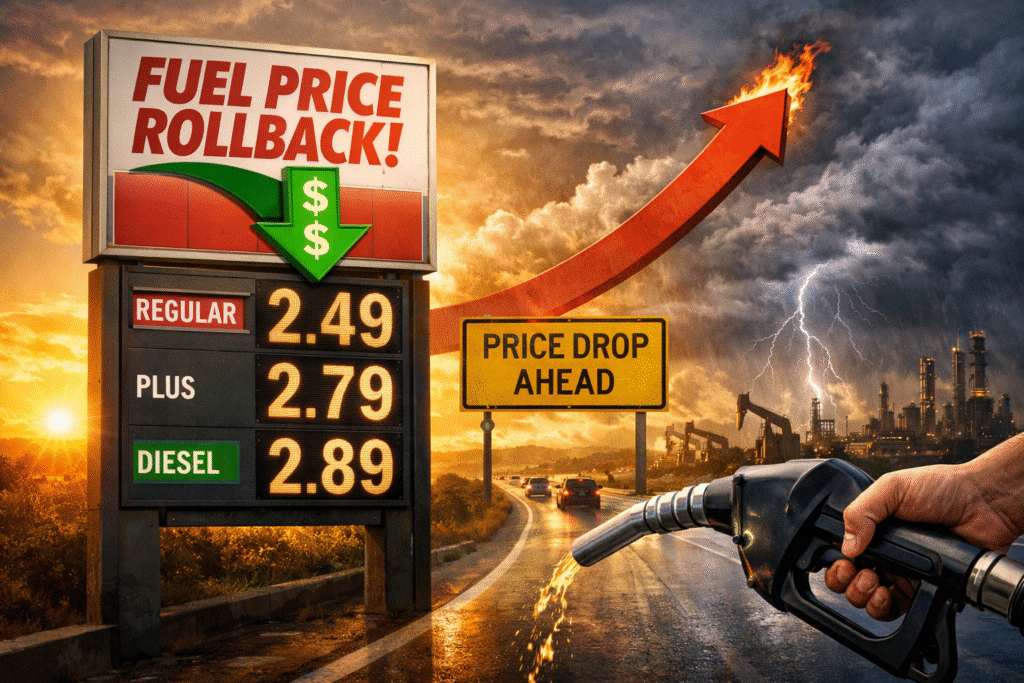
MANILA (April 19) — Filipino motorists are set for the sharpest fuel price cuts in recent months, but officials and analysts warn that the relief may be temporary, as domestic prices remain tightly tied to volatile global energy conditions.
President Ferdinand Marcos Jr. announced in a vlog that diesel prices could drop by as much as P24.94 per liter, gasoline by P3.41, and kerosene by P2 next week—describing the rollback as a “bigger-than-last-week” adjustment driven by easing geopolitical tensions abroad.
Oil companies are expected to implement the new pump prices on Tuesday, according to industry sources.
The expected cuts follow a steady decline in global crude prices, driven by easing tensions in the Middle East, including a ceasefire between Israel and Lebanon and improved market sentiment after reduced disruption risks in key supply routes such as the Strait of Hormuz.
Benchmark Dubai crude fell to around $104.93 per barrel this week, reflecting softer global energy prices after weeks of volatility.
But while the rollback offers immediate relief, analysts caution that the underlying volatility has not disappeared. Fuel prices in the Philippines remain highly sensitive to external shocks, meaning sharp increases and declines often reflect global developments rather than domestic stability.
Even with the expected reductions, pump prices remain significantly higher than pre-conflict levels, highlighting how partial relief often follows earlier spikes rather than restoring long-term affordability.
Relief measures alongside price cuts
The government has urged oil firms to pass on reductions without delay.
“Every centavo reduction should be felt by every Filipino,” Marcos said, adding that relief should reach consumers quickly and fully.
Alongside the rollback, targeted interventions remain in place, including a P10 fuel subsidy for public utility vehicles and expanded service contracting for transport workers.
The Department of Transportation said over 19,000 public utility vehicles are expected to participate in the program, supported by an initial P1 billion allocation and a proposed additional P5 billion in funding.
The initiative aims to stabilize driver incomes while ensuring commuter mobility, particularly in high-demand urban routes.
Additional assistance is being extended to delivery riders, with more than 100,000 beneficiaries receiving cash aid facilitated by the Department of Information and Communications Technology and the Department of Social Welfare and Development.
Cyclical relief, structural exposure
While the combination of subsidies and price rollbacks provides short-term cushioning, it also underscores a structural issue: the Philippine economy remains heavily exposed to global oil price swings.
Transport operators, logistics providers, and commuters continue to absorb the impact of rapid fuel price fluctuations, with diesel volatility particularly affecting public transport and goods movement.
Economists note that recent declines are largely driven by external geopolitical easing rather than domestic supply reforms, making sustained stability uncertain.
Relief today, uncertainty tomorrow
For consumers, the coming rollback will offer immediate financial relief. But for policymakers, it reinforces a recurring challenge: managing an economy where fuel prices remain largely determined by events far beyond domestic control.
As global markets continue to swing with geopolitical developments, the expected price cuts serve as a reminder that while relief can be swift, it is often conditional—and rarely permanent.