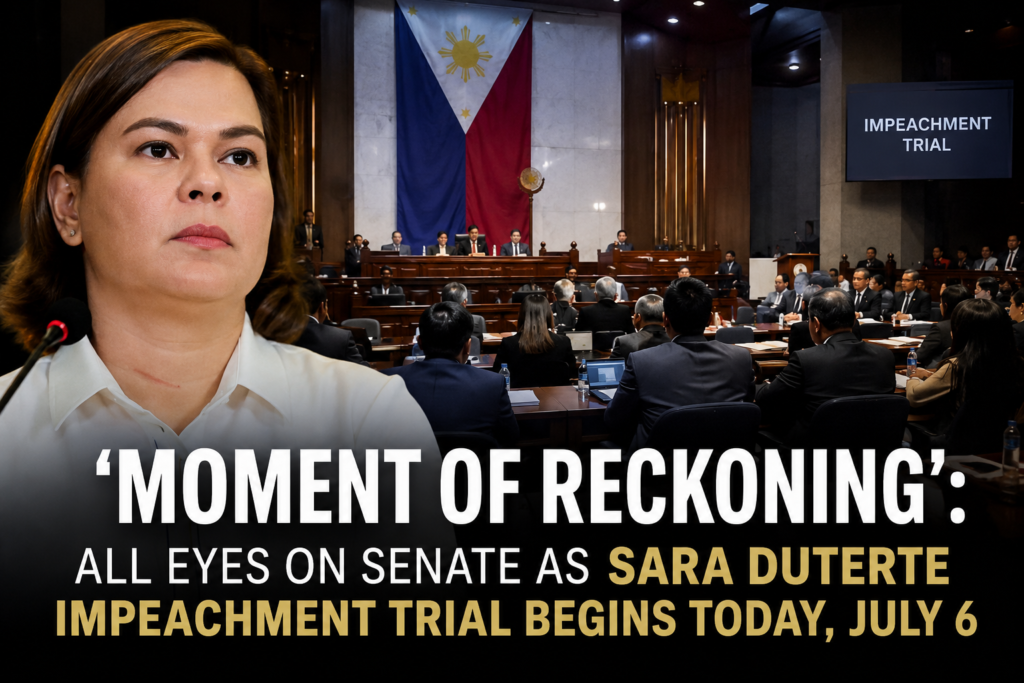
MANILA(July 6) — Months of political confrontation will culminate Monday as the Senate formally opens the impeachment trial of Vice President Sara Duterte, setting in motion a historic process that will test not only the allegations against her but also the credibility of the country’s democratic institutions.
The trial, scheduled to begin at 2 p.m., comes after weeks of legal maneuvering and public debate over whether the proceedings would push through. For many Filipinos, Monday marks the first opportunity to see evidence presented in open court on accusations that have fueled one of the country’s deepest political rifts.
House prosecutors said they are fully prepared to present their case and challenged Duterte to personally attend the proceedings.
“The long wait is over. On Monday, we expect the trial to begin, as our countrymen have long waited for,” House prosecutor Rep. Joel Chua said Sunday.
The prosecution is also asking the Senate impeachment court to allow both Filipino and English during the trial, arguing that a case involving the nation’s second-highest official should be fully understood by the public.
Duterte was impeached by the House in May over allegations that include misuse of confidential funds, unexplained wealth, bribery involving Department of Education personnel and grave threats against President Ferdinand Marcos Jr., First Lady Liza Araneta-Marcos and former House Speaker Martin Romualdez.
The Senate will first hear the article accusing Duterte of making grave threats before moving to the other impeachment charges.
House prosecutors have lined up National Bureau of Investigation Bangsamoro Regional Director Jeremy Lotoc, NBI Senior Agent John Mark Calilung and House Legislative Security Bureau Director Belinda Bello among their initial witnesses.
If the timetable is followed, the impeachment court could spend as many as 92 trial days hearing evidence and witness testimony.
More than a legal battle
Monday’s opening also places the Senate under intense public scrutiny.
Senators will serve not as legislators but as impeachment judges, weighing evidence that could determine whether Duterte remains in office or is removed and barred from holding public office in the future.
Once Congress resumes its regular session on July 27, senators will divide their time between legislative work in the morning and impeachment proceedings in the afternoon.
Senate President Sherwin Gatchalian acknowledged the demanding schedule but said the chamber is prepared to fulfill its constitutional duty.
Will Sara Duterte appear?
One of the biggest questions before Monday’s proceedings is whether Duterte herself will attend.
Under Senate impeachment rules, she is not required to appear personally and may leave the proceedings entirely to her legal team.
Still, House prosecutors, Malacañang officials and civil society groups have urged her to face the impeachment court directly, arguing that public confidence in the process depends not only on the evidence presented but also on the willingness of those involved to be accountable.
“Our one wish is that VP Sara doesn’t ghost the Filipino people on Day 1 of the trial,” House trial spokesperson Rep. Renee Co said.
House legal spokesperson Benjamin Tolosa Jr. said Duterte’s absence would not affect the prosecution’s presentation of evidence.
“We will still present our evidence, call all of our witnesses, regardless if she’s there or not,” he said.
Trial likely to shape political landscape
Beyond determining Duterte’s political future, the impeachment trial is expected to influence the country’s political climate ahead of future elections.
House prosecutors said they intend to counter misinformation with documentary evidence and witness testimony, warning that false narratives are likely to intensify as the trial progresses.
Chua cited an internal survey showing that 82 percent of respondents support allowing the impeachment trial to proceed, saying the figure reflects the public’s desire to see the constitutional process completed rather than a judgment of guilt.
Former Integrated Bar of the Philippines president Domingo Cayosa said the Senate impeachment court—not the Supreme Court—has the constitutional authority to decide the case, reinforcing the significance of the proceedings that begin Monday.
For millions of Filipinos watching closely, the trial represents more than the fate of one elected official. It is a defining test of whether the country’s constitutional mechanisms for accountability can withstand intense political pressure—and whether the truth behind the allegations will ultimately be decided through evidence presented in open court rather than in the court of public opinion.