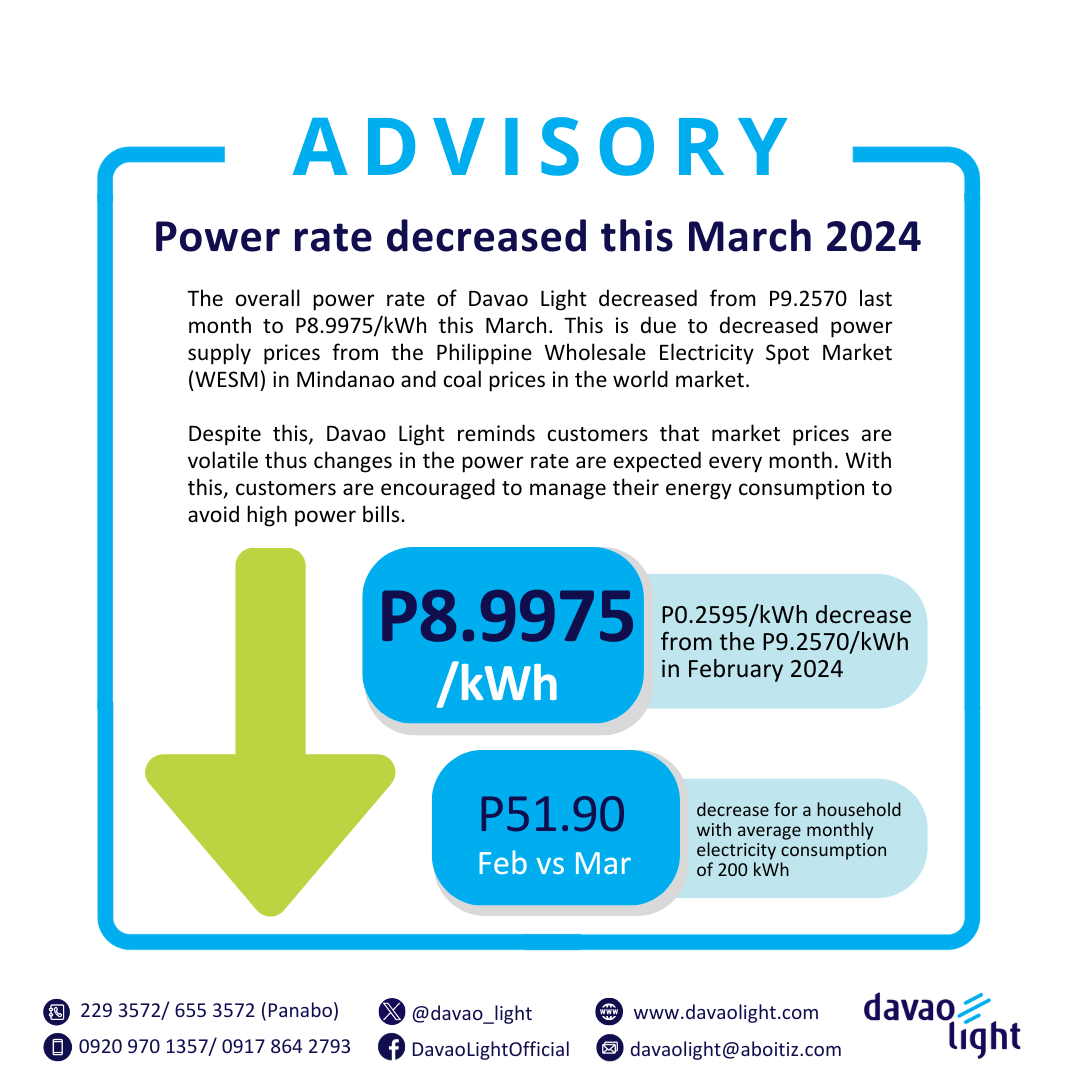
DAVAO CITY — Residential customers of Davao Light and Power Co., Inc. (Davao Light) will see a decrease in their bills from March 12 to April 10, 2024, as the overall power rate is down to P8.9975 per kilowatt-hour (kWh) from P9.2570 last month.
The P0.2595/kWh decrease in power rate is due to reduced generation rates brought about by decreased power supply prices from the Philippine Wholesale Electricity Spot Market (WESM) in Mindanao and coal prices from the world market. A typical household with an average monthly electricity consumption of 200 kWh will experience a drop of P51.90 compared to their February billing.
Despite this, the power utility reminds customers of possible high electricity consumption, especially since El Niño is here.
According to the latest climate monitoring of the Philippine Atmospheric, Geophysical and Astronomical Services Administration (PAGASA), the country’s weather bureau, the ongoing El Niño will likely persist until March, April, and May 2024, as suggested by the majority of global climate models.
“The lower power rate is a positive development for our customers following slight rate increases in the past two months,” said Fermin Edillon, Davao Light Reputation Enhancement Department Head. “However, even with the decreased rate, our customers may still incur high electricity bills if power usage is not well managed. We encourage them to effectively manage their consumption to avoid high electricity bills.”
It is important to note that monthly bills are affected by two factors – rates and consumption.
Power rates as seen in Davao Light’s unbundled monthly bills are divided into 4 major components: Generation and Transmission, Distribution, Subsidies and Other Charges, and Government Charges and Taxes. Generation and transmission charges are pass-through charges that the distribution utility collects and pays to power suppliers and the transmission operator, respectively. Meanwhile, the distribution charge that goes to Davao Light, and approved by the Energy Regulatory Commission (ERC) has not increased since 2013.
Since power rates are uncontrollable, Davao Light customers can still manage their electricity bills by focusing on their consumption. They can conserve energy by lessening the number of hours or days used for a particular appliance. Moreover, with hotter days come the frequent and longer use of cooling appliances. Davao Light advises customers to open doors and windows or use electric fans with lower consumption than air conditioners.
“March is Fire Prevention Month. It is equally important to apply electrical safety measures alongside energy conservation, as it will benefit our family and community,” Edillon added.
For more energy conservation and safety tips, Davao Light customers may check its official Facebook page DavaoLightOfficial. Meanwhile, for the complete monthly rates, customers may check www.davaolight.com.
Davao Light, an Aboitiz Power Corporation subsidiary, aims to provide its customers with a front-seat vantage point regarding its services, including the sourcing and pricing of its electricity. This is in line with the mission of the company to deliver, at the most reasonable cost, safe and reliable electric service to the people and businesses it serves.