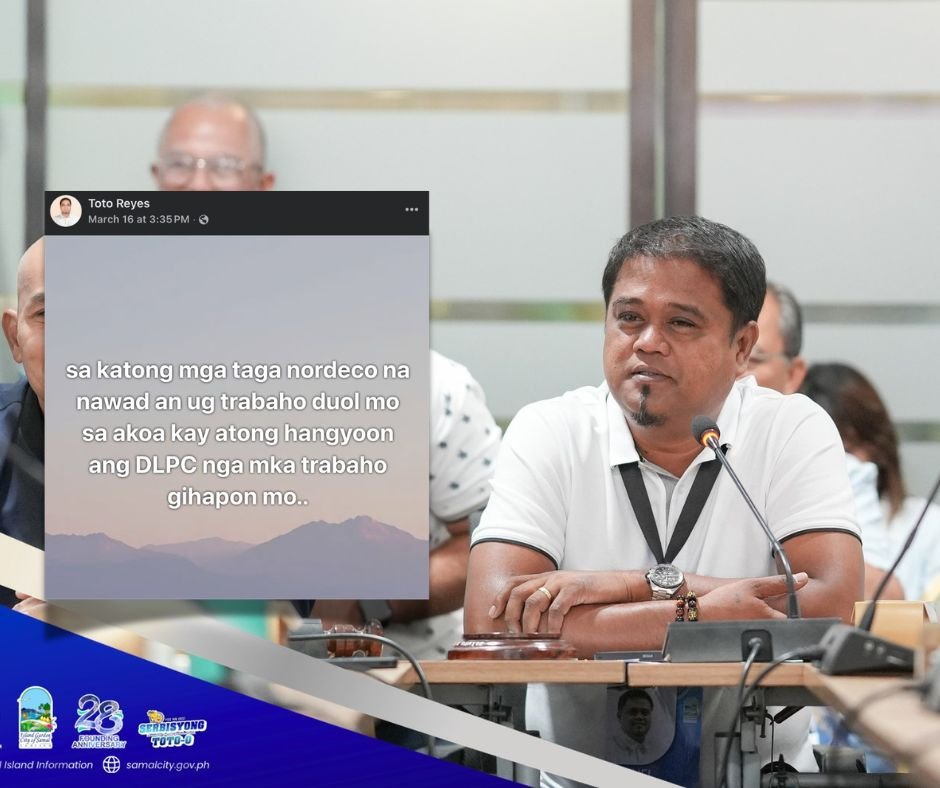
DAVAO CITY (March 19) — As uncertainty grips hundreds of electric cooperative workers in Samal, Island Garden City Mayor Lemuel Toto Reyes has stepped in with a public offer: seek his help in negotiating possible employment with Davao Light and Power Company.
In a Facebook post on March 16, Reyes urged displaced employees of Northern Davao Electric Cooperative Inc. (Nordeco) to approach his office, saying he would personally appeal to Davao Light to absorb affected workers.
“Sa katong mga taga-Nordeco na nawad-an og trabaho, duol mo sa akoa kay atong hangyoon ang DLPC nga maka-trabaho gihapon mo,” Reyes said.
Jobs in limbo
Nordeco employs around 700 workers, many of whom have spent decades in the cooperative. But with Davao Light’s expanding footprint, concerns over job security have intensified—particularly because there is no automatic provision ensuring that existing workers will be retained.
While Davao Light and Power Company has signaled openness to hiring former Nordeco employees, it stopped short of guaranteeing absorption, instead emphasizing that applicants must still meet its qualifications.
For long-time cooperative workers, this shifts the burden from institutional protection to individual competition—raising questions about labor transition policies in utility takeovers.
Expansion backed by law—and contested on the ground
At the center of the dispute is Republic Act No. 12144, which took effect in April 2025 and expanded Davao Light’s franchise to cover parts of Davao del Norte and Davao de Oro, including Samal Island.
The company has anchored its takeover on both the law and a 2026 ruling by the Supreme Court of the Philippines upholding its constitutionality. It has also cited a writ of possession issued by a Panabo court, authorizing it to assume control of distribution assets in Samal.
However, Northern Davao Electric Cooperative Inc. disputes the narrative that the transition is settled.
The cooperative insists that legal proceedings are ongoing and that claims of exclusive authority are “misleading and premature.” It maintains that its franchise remains valid and could legally coexist with Davao Light’s—citing constitutional provisions and past jurisprudence involving power distribution disputes in Iloilo.
A transition without a safety net?
Beyond the legal battle, the situation exposes a recurring issue in infrastructure transitions: the absence of a clear labor protection framework.
Unlike other sectors where privatization or franchise transfers include employee absorption clauses or transition packages, the Samal case leaves workers navigating uncertainty largely on their own.
Mayor Reyes’ intervention, while welcomed by some, also underscores the ad hoc nature of current solutions—relying on political facilitation rather than institutional guarantees.
What comes next
As legal questions remain unresolved, the immediate concern for many Nordeco workers is livelihood.
Whether Davao Light’s hiring window translates into real employment opportunities—or leaves long-serving cooperative employees sidelined—will likely shape public sentiment around the transition, especially in a community now caught between competing claims of authority and service delivery.
For now, displaced workers are left balancing hope in local mediation with the realities of a rapidly shifting power landscape.