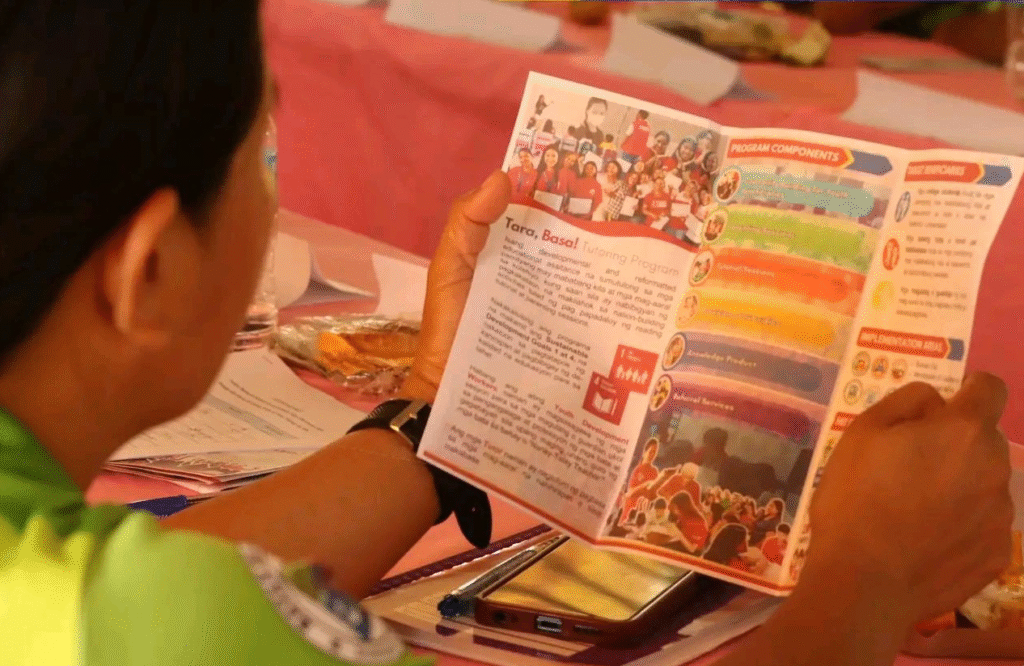
BUTUAN CITY(May 5) — What began as a literacy push by the Department of Social Welfare and Development (DSWD) has grown into something far more powerful—an initiative that uplifts children, sustains struggling students, and transforms parents into partners in learning.
The “Tara, Basa!” program is not just about teaching Grade 2 pupils how to read. It is about changing lives on three fronts: improving literacy among young learners, providing income to indigent college students, and equipping parents to support education at home.
For 26-year-old education student Adelyn Limnoan of Caraga State University, the experience went far beyond the classroom.
“More than the stipend I received as a tutor, the experience I had tutoring struggling learners was just priceless,” she said.
Like other student-tutors, Adelyn conducted 20 days of face-to-face sessions with non-readers and struggling readers. But what stayed with her were not just the lessons delivered—it was the connections formed.
One of her learners, a child with disability, faced challenges that extended beyond reading. Yet day by day, progress came—slow, but meaningful.
“Every small progress felt like a victory,” Adelyn shared. “Seeing the child’s determination reminded me that teaching is not just about letters and words—it’s about hope.”
Under the program, college students like Adelyn are supported through a cash-for-work scheme, earning wages equivalent to the regional minimum. For many, it is the difference between stopping school and pushing forward.
According to DSWD Caraga information officer Ephraim B. Malazarte, the program draws student-tutors from state universities and colleges, creating a cycle of support that benefits both learners and youth scholars.
The impact is already tangible.
In 2025, the program rollout in Siargao Islands and Butuan City reached hundreds. Siargao alone recorded 535 learners and parents, supported by 106 student-tutors and 54 youth development workers. In Butuan City, 1,260 learners were assisted by 146 tutors and 73 youth workers.
This year, expansion is underway. New areas include Madrid and Cantilan in Surigao del Sur, while a memorandum of agreement signed in April paves the way for implementation in Dinagat Islands.
Beneficiaries are carefully selected using the Community-Based Monitoring System, ensuring that assistance reaches low-income families who need it most.
Sessions are strategically scheduled during school breaks to avoid disrupting classes. Even with the Department of Education (DepEd) shifting to a trimester system by 2026–2027, the program is expected to adapt smoothly.
But “Tara, Basa!” does not stop with the child.
Through “Nanay-Tatay Teacher” sessions, parents are trained—guided by youth development workers—to become active partners in their children’s education. The goal is simple: make learning continue long after tutoring ends.
By blending education, livelihood, and family engagement, the program stands out as a model of inclusive development.
For Adelyn, the takeaway is deeply personal.
The experience was never just about teaching children to read—it was about witnessing resilience, practicing compassion, and celebrating the quiet triumph of a child sounding out words for the first time.
And in those moments, she found something even more valuable than income: purpose.