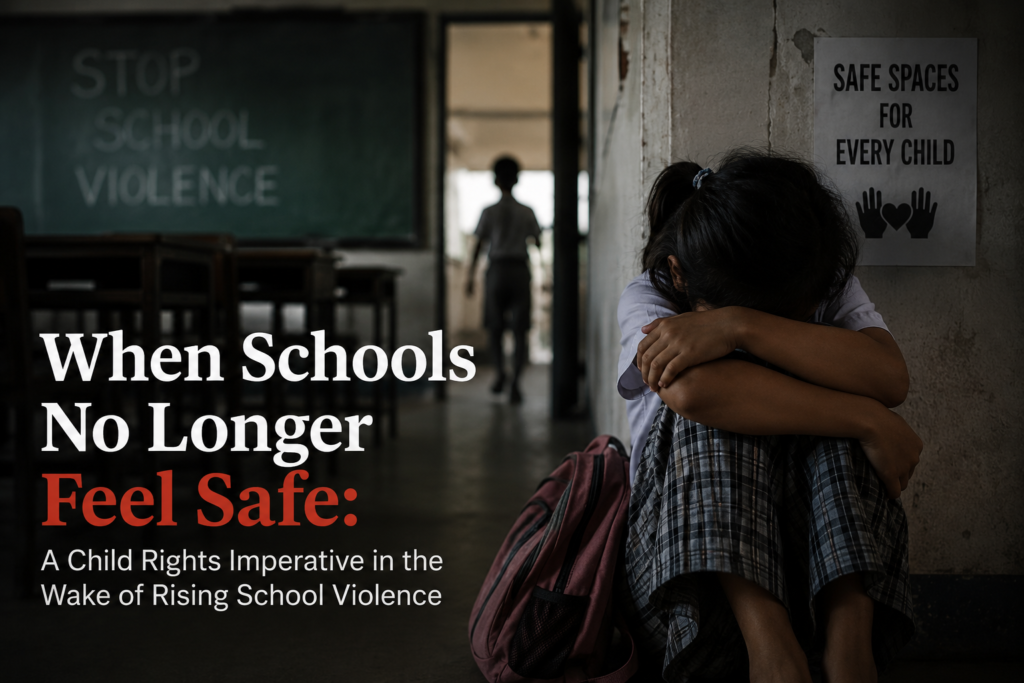
DAVAO CITY (June 24) — The opening of School Year 2026–2027 was supposed to signal new beginnings for millions of Filipino learners. Instead, it has begun under the shadow of a troubling series of violent incidents that have shaken families, educators, and policymakers alike.
Within a single week, three separate attacks unfolded on school grounds.
On June 16, a 14-year-old Grade 8 student armed with a kitchen knife entered a Grade 5 classroom at a private school in General Trias, Cavite, injuring seven children. Three days later, a senior high school student was stabbed multiple times by a fellow learner at a public school in Cavite City. Then, on June 22, one of the deadliest school attacks in recent Philippine history occurred when two teenage boys opened fire inside San Jose National High School in Tacloban City, killing three students and injuring 20 others.
The violence has left many asking not only how such incidents happened, but whether Filipino schools are truly fulfilling their role as safe spaces where children can learn, grow, and thrive.
More Than a Security Problem
The Tacloban shooting has intensified national conversations about school safety. Police investigations revealed that the firearm used in the attack belonged to a police officer related to one of the suspects, raising concerns about children’s access to deadly weapons and the responsibility of adults in safeguarding them.
Education Secretary Sonny Angara described the tragedy as extending beyond issues of campus security. He pointed to factors such as exposure to violence online, inadequate parental supervision, social isolation, and the growing influence of youth gangs.
These observations highlight an important reality: school violence rarely emerges in isolation. It is often the culmination of multiple unmet protection needs—within families, schools, communities, and broader social systems.
Viewed through a child rights lens, the recent incidents are not simply criminal acts. They are indicators of deeper failures in prevention, protection, mental health support, and early intervention.
The Hidden Crisis Behind the Headlines
Long before the attacks in Cavite and Tacloban, warning signs were already visible.
The Second Congressional Commission on Education (EDCOM 2) has repeatedly raised concerns about bullying, classroom disruption, overcrowding, and insufficient student support services. According to international assessments, Filipino learners continue to experience bullying at rates significantly higher than global averages.
While recent data suggest some improvements, roughly one in three Filipino students still reports experiencing bullying. For many children, schools remain environments where intimidation, exclusion, humiliation, and violence are part of daily life.
Child protection experts warn that bullying is not merely a disciplinary concern. It is a rights violation that can have profound consequences for children’s mental health, educational outcomes, and overall well-being.
Children subjected to repeated victimization may experience anxiety, depression, trauma, and social withdrawal. Some may disengage from school altogether. Others may internalize their experiences and eventually express their distress through aggression toward themselves or others.
In this context, acts of extreme violence should not be viewed as isolated events perpetrated by individual children alone. They must be understood within broader systems that may have failed to recognize warning signs or provide timely support.
Every Child Has the Right to Safety
The Philippines is a State Party to the United Nations Convention on the Rights of the Child, which guarantees every child’s right to protection from all forms of violence, abuse, neglect, and exploitation.
This obligation extends to schools.
Under both international and domestic law, educational institutions are expected to provide environments that are safe, inclusive, and conducive to learning. Children have the right not only to access education but also to be protected while receiving it.
The recent attacks expose significant gaps in fulfilling these obligations.
The shortage of guidance counselors remains one of the most pressing concerns. The Department of Education has previously acknowledged that the country has only a fraction of the counseling workforce needed to meet international standards. Without sufficient mental health professionals, schools often struggle to identify learners experiencing emotional distress, behavioral challenges, trauma, or exposure to violence.
This leaves many children without the support they need before problems escalate into crises.
Protecting Victims Without Abandoning Children in Conflict with the Law
The incidents have also reignited debate over the treatment of minors who commit serious offenses.
Calls to lower the minimum age of criminal responsibility have resurfaced in public discussions. However, child rights advocates caution against responses driven primarily by punishment.
Republic Act 9344, the Juvenile Justice and Welfare Act, recognizes that children in conflict with the law require accountability alongside rehabilitation and reintegration. Contrary to widespread misconceptions, the law does not exempt children from responsibility for criminal acts. Rather, it provides age-appropriate interventions aimed at preventing lifelong involvement in crime.
A child rights approach demands that society hold two truths simultaneously: victims deserve justice, healing, and protection, while offending children must also be assessed within the context of their development, family circumstances, mental health needs, and exposure to violence.
The challenge is not choosing between accountability and rehabilitation. It is ensuring both.
Is It Time for Stronger Child Protection Mechanisms?
The succession of school attacks has prompted renewed discussions about strengthening institutional safeguards.
Some education advocates have proposed establishing an Educational Rights Protection Bureau—a specialized body that could investigate serious school-based incidents, monitor compliance with child protection standards, coordinate interagency responses, and provide legal and psychosocial support to affected learners.
The proposal reflects a growing recognition that child protection cannot rest solely on the shoulders of individual schools.
Lessons from neighboring countries suggest the value of dedicated mechanisms. Malaysia has strengthened responses through specialized anti-bullying processes. Indonesia requires schools to establish violence prevention and response teams. Singapore integrates educational discipline systems with broader child protection and juvenile justice frameworks.
In the Philippines, EDCOM 2 has recommended amendments to the Anti-Bullying Act to improve implementation, strengthen accountability, and ensure more consistent protection across schools.
These reforms deserve urgent attention.
Beyond Metal Detectors and Security Guards
While school safety measures such as security personnel, emergency protocols, and surveillance systems may help deter violence, they are only part of the solution.
Children’s safety depends equally on relationships, trust, and belonging.
Experts consistently emphasize the importance of strengthening psychosocial support services, mental health programs, peer-support initiatives, and early-warning systems that identify children at risk of harming themselves or others. Addressing classroom overcrowding, expanding counseling services, and supporting teachers in child protection responsibilities are equally critical.
Parents, local governments, social workers, law enforcement agencies, faith communities, and mental health professionals must also share responsibility for creating environments where children feel seen, heard, and supported.
Most importantly, schools must become places where empathy is actively taught and practiced—not merely through lessons, but through the culture adults create every day.
A National Wake-Up Call
The deaths of three students in Tacloban and the injuries sustained by dozens of other children in recent school attacks represent more than tragic headlines. They are a warning that child protection systems require urgent strengthening.
Every child who enters a classroom carries the expectation that school will be a place of safety, dignity, and opportunity. When violence enters those spaces, it undermines not only education but also children’s fundamental rights.
As the new school year unfolds, the challenge facing the nation is clear: ensuring that school safety is not treated merely as a matter of security, but as a child rights imperative.
For every learner in the Philippines, the right to education must include the right to be safe, protected, and able to learn without fear.